Iran reveals underground missile depot containing Fattah-1 systems
Military officials toured the site on Tuesday, asserting that advanced ballistic and cruise missiles are stored there despite recent aerial campaigns.
By Evelyn Ellis ·
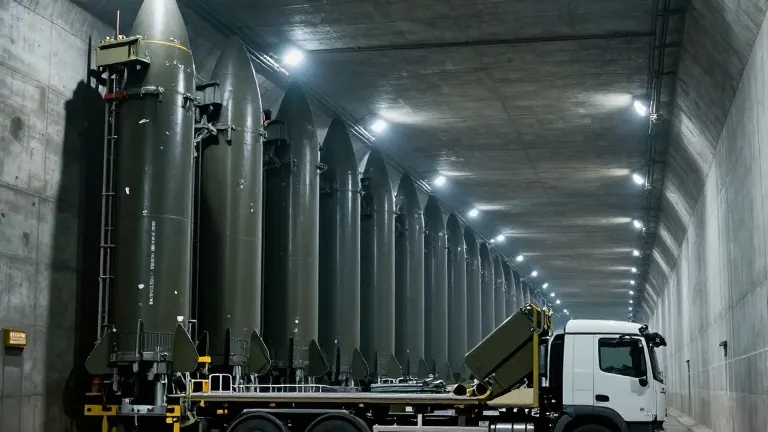
Iran displayed images of a new underground facility on Tuesday, identifying it as a storage site for ballistic and cruise missiles along with their launchers. The Islamic Revolutionary Guard Corps, or IRGC, featured the site in footage released by the Tasnim News Agency. Major General Ali Abdollahi, the chief of staff of the Iranian armed forces, and Brigadier General Majid Mousavi, the commander of the IRGC Aerospace Force, were seen touring the complex. This presentation occurs while Qatar mediates between Washington and Tehran, following a recent meeting between President Donald Trump and Qatari Prime Minister Mohammed bin Abdulrahman Al Thani.
Analysts reviewing the images suggest the depot is stocked with Fattah-1 medium-range ballistic missiles. Osint613 reported that maneuverable re-entry vehicles were visible alongside complete missiles fitted with boosters and warheads. Tal Inbar, an expert on regional military capabilities, noted the presence of a maneuverable re-entry vehicle for the Khiber Shekan missile. He observed that the video also showed older missiles with plain conic re-entry vehicles. One image appeared to show a commercial truck with a missile mounted in the rear, a design that allows the weapon to be hidden in plain sight on roads before being raised into a launch position.
Abdollahi stated that the advanced missiles will surprise enemies with their battlefield impact. According to reports from Rudaw and Iran International, he warned that if the enemy makes another move against Iran, the response will extend beyond the Middle East. This rhetoric arrives as the United States has conducted strikes on Iran’s Qeshm Island. The timing of the reveal suggests Tehran intends to demonstrate that its missile capabilities have survived American and Israeli airstrikes.
The facility’s existence challenges previous assessments of Iran’s military posture. In March, Israel’s prime minister claimed that Iran had lost the ability to produce ballistic missiles. However, the underground design offers a layer of protection that aerial bombardment finds difficult to penetrate. During the 2025 conflict, Israeli forces targeted Iranian launchers and storage facilities. Some launchers were considered destroyed when they were sealed inside tunnels, yet Iran was able to dig them out and resume operations.
Brigadier General Hossein Mohebbi, the IRGC spokesperson, said on November 7 that missile and drone production had moved from aboveground facilities into underground complexes. He claimed the IRGC was establishing missile production cities deep beneath the ground. Mohebbi argued that domestic expertise and flexible infrastructure would allow manufacturing to continue even under heavy bombardment. Satellite imagery reviewed by Reuters in February 2026 showed Iran repairing missile bases damaged during the fighting and reinforcing sensitive military sites.
The new depot serves as a tangible indicator of Tehran’s strategic message. It signals that the country retains a dangerous arsenal despite repeated strikes aimed at degrading its capabilities. The United States remains optimistic about reaching an agreement with Tehran. Iran appears equally confident in its position as it continues to expand its underground infrastructure.