NASA Probe Crosses One Light-Day Mark, Signaling 24-Hour Delay to Earth
Voyager 1 has traveled over 16 billion miles, making its radio signals take a full day to reach controllers in California.
By Bruno Morales ·
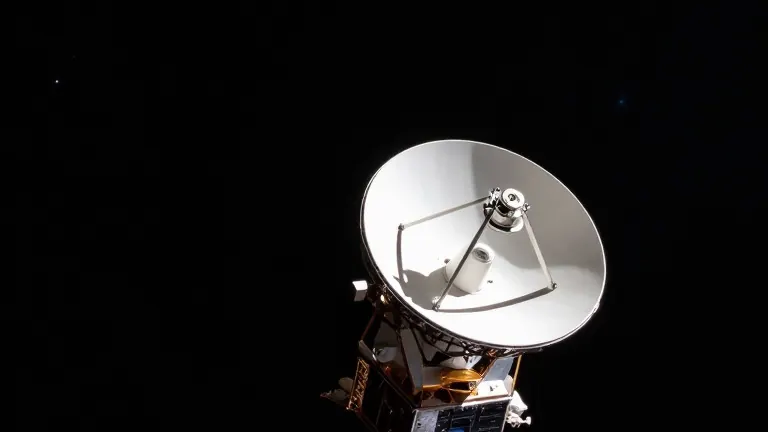
NASA’s Voyager 1 spacecraft crossed a new threshold this week, becoming the first human-made object to reach a distance of one light-day from Earth. This milestone means that radio signals sent by the probe now take exactly 24 hours to travel back to the planet at the speed of light. The achievement confirms the craft’s steady movement into the deep regions of interstellar space.
The spacecraft is currently more than 16 billion miles away from its launch site. It was sent into orbit 49 years ago. Suzanne Dodd, the project director for the mission, describes Voyager 1 as an ambassador for Earth traveling between stars. She told The Associated Press that the mission provides a sense of awe and considers the probe a national treasure.
Despite its age, the craft continues to function and send data. It travels at a speed of 38,000 miles per hour. The probe experiences occasional issues typical of aging equipment, yet it maintains its trajectory. Its twin, Voyager 2, was launched two weeks earlier in 1977. NASA estimates that Voyager 2 will not reach the one-light-day mark until 2035.
Voyager 1 flew past Jupiter in 1979 and Saturn in 1980. It entered interstellar space in 2012. The probe sends information about its environment almost every day. This data includes the strength and direction of magnetic fields, local pressure, dust levels, and galactic cosmic rays. Dodd compares these transmissions to weather satellite reports.
A small team at NASA’s Jet Propulsion Laboratory in Pasadena, California, manages the mission. They send commands to the spacecraft approximately once a week. The team sometimes receives assistance from retired engineers who worked on the project previously. In September, the controllers completed an effort to conserve the energy of the plutonium-powered craft. In October, they lost contact with the probe briefly and are still investigating the cause of that interruption.
The mission has held several records for decades. In 1990, Voyager 1 took the most distant photograph of Earth, known as the Pale Blue Dot. The image was captured from beyond Neptune. Carl Sagan, an astronomer at Cornell University who worked on the imaging team, presented the photo to the public in 1990. He noted that every human who has ever lived has done so on that small dot in a vast cosmic arena.
Each Voyager spacecraft carries a 12-inch gold-plated phonograph record. The disc contains greetings in 55 languages, along with images and diagrams. Sagan included the voice of his son, Nick, who was six years old at the time. Nick said, "Hello from the children on planet Earth." The team added a needle and instructions for anyone who might find the object. Dodd described the record as a time capsule of life on Earth in 1977.
Bill Nye of the Planetary Society stated that everyone on Earth has been touched by these missions. The society was co-founded in 1980 by Sagan, who died in 1996. Dodd hopes that someone or something may find the record within 1,000 years.