Coyote tests Agoura Hills wildlife bridge ahead of December opening
The first large mammal to use the new overpass cannot yet complete a full crossing, but crews are adjusting the terrain to connect the two spans.
By Evelyn Ellis ·
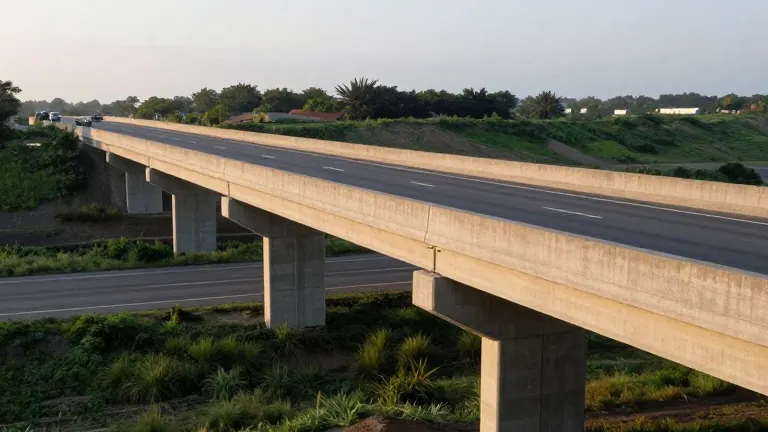
A coyote became the first large mammal to use the Wallis Annenberg Wildlife Crossing on the 101 Freeway on Wednesday morning. A camera installed on the south slope near Agoura Road captured the animal at 6 a.m. The National Park Service released the black-and-white image, showing the coyote's eye reflecting light as it moved up the hillside.
The structure is not yet fully functional for large animals. It consists of two overpasses, one spanning the freeway and one spanning an adjacent road, connected by a graded slope. The soil bridge between them is currently too low, preventing the coyote from traveling the full length. Crews are now rapidly adding soil to create a seamless connection. This modification will allow mountain lions, bobcats, and coyotes to cross safely between the Santa Monica Mountains and the areas beyond.
Beth Pratt, president of the Wildlife Crossing Fund, said she urged the installation of the monitoring camera. She stated that she texted National Park Service wildlife biologist Jeff Sikich daily until the device was placed on Oct. 14. Upon seeing the initial image of the coyote, Pratt said, “Oh my God, it’s already working.”
Sikich rushed to the site on Tuesday to install six additional cameras on the crossing itself. The project plans to use more than 50 still cameras and four thermal video cameras for remote monitoring. The data will not be streamed live but will be shared with the public. These tools will track movement and physiological stress in animals using the bridge.
The crossing is a $114 million project intended to reconnect wildlife populations isolated by the freeway and development. Scientists have studied carnivores in the Santa Monica Mountains since 1996, when they began radio-collaring bobcats and coyotes. Research expanded to mountain lions in 2002. The current focus includes implanting biologgers in deer and mountain lions to track heart rate, body temperature, and fat reserves.
Mountain lions in the region face critical genetic diversity issues due to inbreeding, which has resulted in physical deformities such as kinked tails. The bridge allows these cats to seek mates in the Simi Hills, introducing new genetic material into the local population. Sikich noted that even a single breeding event could make a meaningful impact on the health of the population.
The project is scheduled to open on Dec. 2. While it previously faced political backlash and weather delays, the current primary risk to the deadline is winter storms. Cameras near the southern end have already recorded other wildlife, including a mountain lion with two kittens and an uncollared lion, in the two months prior to the coyote's appearance.