Iran Caps Subsidized Bread at 8 kg in Three Provinces
Buyers in Markazi, Khuzestan, and Zanjan now pay five times the subsidized price once their monthly flour allotment runs out.
By Bruno Morales ·
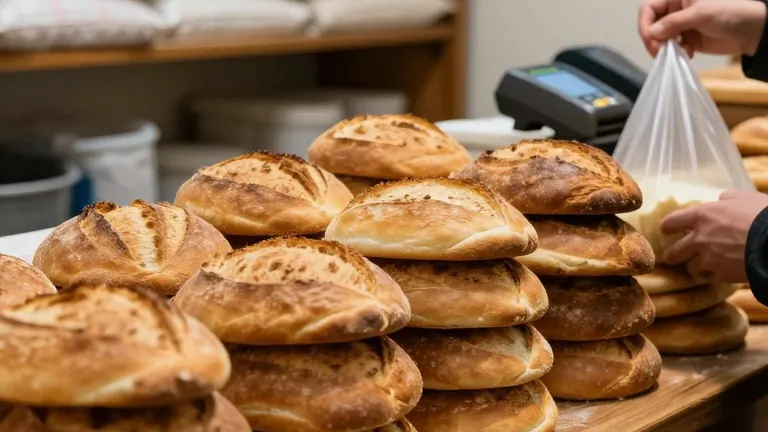
Iran has begun restricting the amount of subsidized bread each household can purchase in three provinces. The limit applies to Markazi, Khuzestan, and Zanjan. Under the new rule, each person receives a monthly quota of roughly 8 kilograms of flour.
The subsidized price stands at 23,000 rials per kilogram. This is less than one US cent. Once a household exceeds the 8 kg limit, the price jumps to the free-market rate of 126,500 rials per kilogram. That is about 5 cents. The price gap is five to one.
The Interior Ministry calls the plan bread purchase management. It took effect through bakeries card readers. There was no public announcement. Neither bakers nor customers received prior notice, according to Iranian media reports from November 18.
Critics have questioned the timing and method of the rollout. The hard-line daily Keyhan accused President Masud Pezeshkian’s government of a secret and suspicious implementation of bread rationing. The paper said the move caused people to rush to bakeries. The reformist daily Sharq also criticized the government’s quiet approach.
The conservative Tabnak website argued that eating more bread is a sign of poverty, not abuse. It noted that low-income families rely on bread when other food is unaffordable. This comments on officials who have complained about rising demand for subsidized loaves.
President Pezeshkian defended the tighter controls on November 18. He pointed to large-scale abuse of cheap energy and staples. He cited examples such as repeated fuel purchases at petrol stations in a single day. He also mentioned crypto miners running on subsidized power. He said some individuals bought up to 18 tons of subsidized bread a month.
The cost of bread looks small in dollar terms because the Iranian currency has collapsed. The dollar trades at around 2.7 million rials on the open market. The monthly minimum wage of about 166 million rials is worth roughly $61. This context explains why the 8 kg limit feels tight for many families.
Sweden-based economist Ahmad Alavi told RFE/RL’s Radio Farda that the bread curbs follow a familiar pattern. He said Iran is under a sea, land, and air blockade. Oil and export revenues are shrinking. Recession makes it impossible to raise taxes. He described the sequence as rationing goods first, then cutting the ration, and sending consumers to the free market.
Alavi said the resources freed up go to the establishment to finance its priorities. He listed those priorities as the war with the United States, regional proxies, and domestic security forces. He argued that a flat per-capita quota ignores how different Iranian households are. He called this inverse allocation, where those who do not need the subsidy get it and those who do lose out.
Alavi said the state is targeting the end of the supply chain because it is the easiest point to control. He referred to Iran’s large informal economy. He warned that costs would show up later as lost social capital, deeper poverty, and malnutrition. He said the state would end up paying for these issues in health care. He concluded that the plan is efficient neither in execution nor in saving money.