Spanish High-Speed Rail Crash Kills 69 in Toledo
Investigations focus on a failed communication system and human error following a collision that derailed trains on the Madrid-Sevilla line.
By Bruno Morales ·
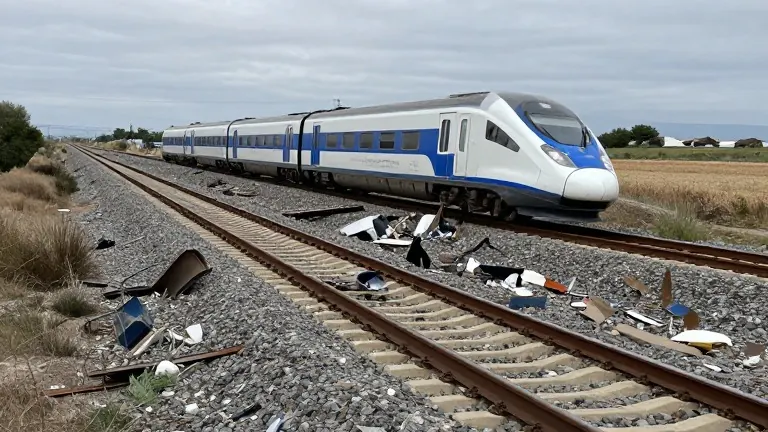
Sixty-nine people died on Wednesday when two high-speed trains collided in the province of Toledo, marking the second major rail disaster in Spain this year. The crash derailed wagons and destroyed parts of both trains, sending shockwaves through a national network that had avoided fatal accidents for over three decades.
The government attributes the accident to a critical failure in the LZB communication system, which monitors train positions and can trigger automatic braking. At 8:30 a.m., the system went down, forcing human controllers in Madrid to manage safety manually. They oversaw a 63-kilometer stretch of track between Madrid and Sevilla where six trains were operating at the time.
According to the government timeline, a controller instructed a state-owned RENFE train to resume normal speed at 8:36 a.m. A private IRYO train, located 25 kilometers ahead, attempted to restart but remained stopped because its driver could not cancel the automatic brake. The two trains collided at 8:53 a.m. Investigators estimate the RENFE train was traveling between 160 and 200 kilometers per hour at impact.
Transport Minister Oscar Puente called the controller's decision to allow the RENFE train to move "inexplicable" and "erroneous." He noted that a red stop signal was still active on the line. Puente stated that the decision was made while one train was stationary, a situation he described as a clear error in judgment.
Railway unions reject the narrative of a single human error, pointing instead to systemic labor shortages. Raquel Ayllon, spokesperson for the SCF union, argued that controllers have been dealing with excessive workloads for years. She stated that blaming one worker for working under worsening conditions ignores the fact that the safety system fails regularly.
Diego Martin of the SEMAF drivers' union noted that the 30-year-old LZB system has malfunctioned repeatedly in the past. He argued the technology should have been replaced long ago. Union members joined a pre-scheduled strike on Thursday to demand the government fulfill its promises to improve safety following the January crash, which killed 46 people.
King Felipe VI visited injured passengers in a Toledo hospital on Thursday, saying the investigation must determine how and why the catastrophe occurred. He emphasized the need to study measures to prevent such events in the future. The crash has intensified scrutiny over the privatization of Spain's rail network, which opened to private operators in 2021.
Traffic on the lines has increased since the market opened to competition. Between Madrid and Barcelona, daily trips rose from 56 in 2019 to 89 in 2024, according to SCF data. Joan Rodriguez, a union spokesperson, said this growth places additional pressure on the infrastructure. Police with search dogs examined the wreckage on Friday morning, while investigators handed over the trains' black boxes to the Civil Guard for inspection.