President enters Polish constitutional court after judge suspension sparks night of clashes
Karol Nawrocki arrived at the courthouse shortly before 1 a.m. on Saturday after government-appointed judges removed the court president, leading to a standoff with riot police.
By Evelyn Ellis ·
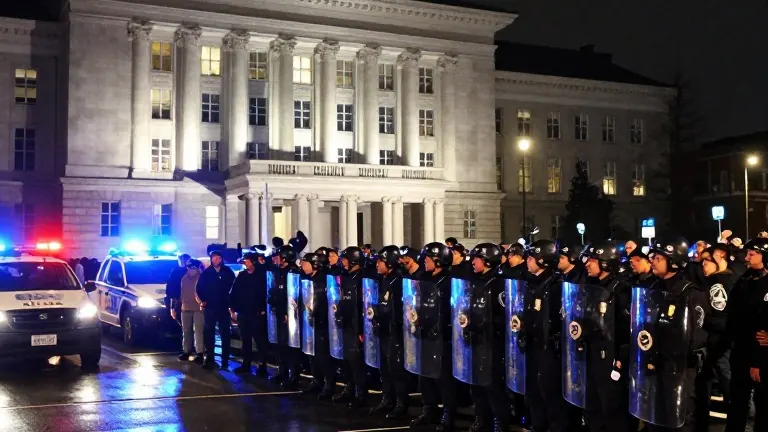
Three people were arrested Friday night as riot police locked in a tense standoff with hundreds of protesters outside Poland’s constitutional court. The confrontation began after a group of government-appointed judges suspended the court’s president, Bogdan Święczkowski, and his deputy, Bartłomiej Sochański. This latest move escalated a decade-long dispute over the legal status of the bench.
The suspension triggered an immediate reaction from the rightwing Law and Justice party. Its leader, Jarosław Kaczyński, described the action as an assault on the court. President Karol Nawrocki, a close ally of Donald Trump, turned his plane around while traveling to Senegal to intervene in Warsaw. He arrived at the building shortly before 1 a.m. on Saturday, pushing through a police cordon to enter the premises. Video footage showed the president tussling with security staff and other judges to gain access. As of 4 a.m. local time, he remained inside.
In a clip posted online, Nawrocki stated that the government appointees were not judges of the constitutional court. At 5 a.m., a statement read on his behalf criticized a violation of Poland’s constitutional order, claiming a constitutional body was seized by force. The statement called for security forces to leave the premises. The court has long been a flashpoint in Polish politics, with past rulings favoring national legislation over European Union law. The European Union accused the court of being too close to nationalist political power.
The dispute dates back to 2015, when competing governments stacked the bench with their own appointees. Prime Minister Donald Tusk returned to power in 2023 and pledged to reverse controversial reforms to mend relations with Brussels. However, his efforts were blocked by opposition-aligned presidents who used veto powers. This year, Nawrocki refused to swear in five judges elected by the current parliament, complicating the legal situation. The Venice Commission, a Council of Europe advisory body, said the president’s refusal should not prevent those judges from taking their posts.
Legal experts remain divided on the legality of the suspension. Marcin Matczak, a prominent law expert, said the legal basis for removing Święczkowski was non-existent. Justice Minister Waldemar Żurek announced he had requested that Święczkowski and Sochański be stripped of legal immunity to face prosecution for obstructing the court. Tusk insisted that restoring the rule of law was a duty, calling the process difficult but necessary. He pledged earlier this month that the court would begin work in accordance with the constitution regardless of public opinion.
Foreign Minister Radosław Sikorski told reporters in Atlanta that the tribunal was politicized under the previous government. He said the current actions aim to allow duly elected judges to make the tribunal function again. Opposition leaders and the court’s social media account accused the government of a judicial coup d’état. Several European far-right figures, including Nigel Farage and Geert Wilders, condemned the move. US Ambassador Tom Rose described the events as very serious, warning that the large gathering outside the tribunal made the situation more combustible.
The next major political test is next year’s parliamentary election. Polls show the populist-right has a chance to return to power. The current standoff sets the scene for a dramatic showdown in the electoral race. Anna Korwin-Piotrowska, one of the five judges not accepted by Nawrocki, claimed the top position citing her long experience in the judiciary. The government and opposition continue to offer sharply different accounts of the night’s events.