Three Drone Strikes in Three Days Test U.S. Naval Presence in Gulf
Tehran targeted American radar systems in Bahrain, prompting analysts to question whether Iran will escalate further to break the economic blockade.
By Andres Smirnov ·
Iran launched a series of drone attacks on U.S. military assets in Bahrain on Tuesday, marking the third such strike in a single week. The assault targeted a radar facility and followed similar hits on Friday and Sunday, signaling a sharp shift in Tehran's tactical approach after a two-month period of relative inactivity. Bahraini officials stated that air defense systems intercepted the incoming fire, describing the operation as a successful defense against treacherous aerial attacks.
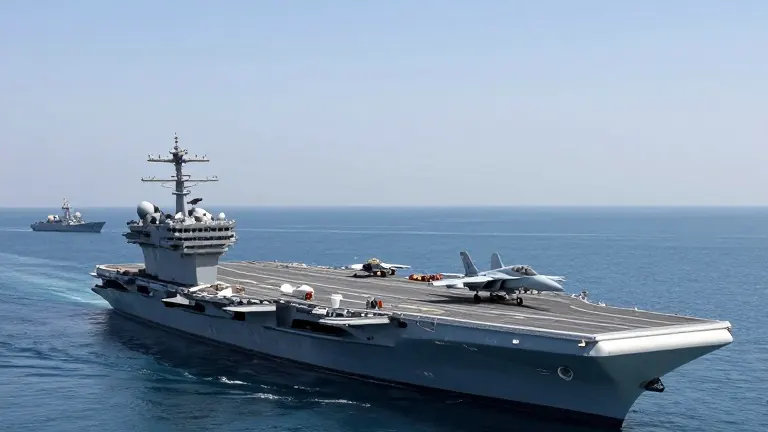
The U.S. military confirmed that all drones were downed without resulting in damage to equipment or injury to American personnel. Despite the lack of physical destruction, the frequency of the attacks has altered the strategic dynamic in the Persian Gulf. Central Command reported that the USS Theodore Roosevelt carrier strike group recently arrived in the region. This deployment adds a third aircraft carrier to the area, joining the USS George H.W. Bush and the USS George Washington, which are currently maintaining a blockade on Iranian shipping.
According to a new analysis by Israel’s Institute for National Security Studies, the combined U.S. naval force in the Persian Gulf, Arabian Sea, Red Sea, and Mediterranean now exceeds the strength deployed at the start of the war in late February. The expanded presence offers greater offensive firepower and improved missile interception capabilities. U.S. Central Command did not specify whether all three carrier groups would remain in the region indefinitely or if the USS George Washington would eventually be rotated out.
Tehran-based security analyst Mostafa Najafi told The Associated Press that Iran has moved from a reactive posture to a preemptive strategy. He noted that the shift aims to counter threats during their formative stages. "Tehran has shifted toward a more active, preemptive strategy, one focused on countering threats during their very formative stages," Najafi said. The Revolutionary Guard Corps stated in a statement that continued aggression against Iranian airspace and the use of regional bases for hostile acts would not go unanswered.
Hamidreza Azizi, a senior analyst at the International Crisis Group, wrote on X that the recent strikes complicate prospects for a negotiated settlement. He observed that as the U.S. weighs whether to resume full-scale attacks or intensify the blockade, Iranian leaders are assessing if escalation is less costly than accepting the status quo. Azizi argued that the risk of renewed war now depends on whether Tehran concludes that the costs of restraint outweigh the risks of further conflict.
Sascha Bruchmann, a defense analyst at the International Institute for Strategic Studies, said the attacks reflect growing Iranian impatience with the waiting game. "Shooting at ships causes fear, but is not effective enough to change the strategic equation," Bruchmann told the AP. He added that while Tehran knows it needs to act, analysts should not overestimate the immediate impact of the Bahrain strikes. Iranian officials have described the current situation as no war, no peace, while signaling readiness to escalate in response to tightening sanctions.
The maritime threat extends beyond the Gulf. The United Kingdom Maritime Trade Organization reported on Tuesday that a tanker was attacked twice north of Oman, with the second strike causing a fire. Iran’s Fars news agency reported that two ships were hit by mines in the Strait of Hormuz. In Yemen, Houthi rebels have solidified control of the Bab el-Mandeb Strait after allied government forces retreated over the weekend. Two Yemeni military officials said those forces are now deploying troops and equipment in the Tur al-Baha district of Lahij province to fortify defenses around Aden.